
For many pet parents, dental care sits at the uneasy intersection of cost, safety, and compassion—especially when the words “general anesthesia” enter the conversation. Many dog owners cringe at the idea of putting their beloved pet “under” for any reason, and many also worry about the extra cost involved. Yet most veterinarians strongly recommend that dogs have their teeth cleaned at least once per year.
In recent years, anesthesia-free dentistry for dogs has been promoted as a gentler, cheaper alternative to traditional veterinary dental cleanings. As the name implies, anesthesia-free cleaning does not use any type of sedation, and is performed while the dog is awake. Supporters point to reduced risk and quicker recovery, while critics argue it falls short of addressing real dental disease. So what does this procedure actually accomplish, and where does it fall short? Understanding the pros and cons is essential before deciding what’s truly best for your dog’s long-term health.
What is the difference between anesthesia-free dental cleaning and dental cleaning under anesthesia?
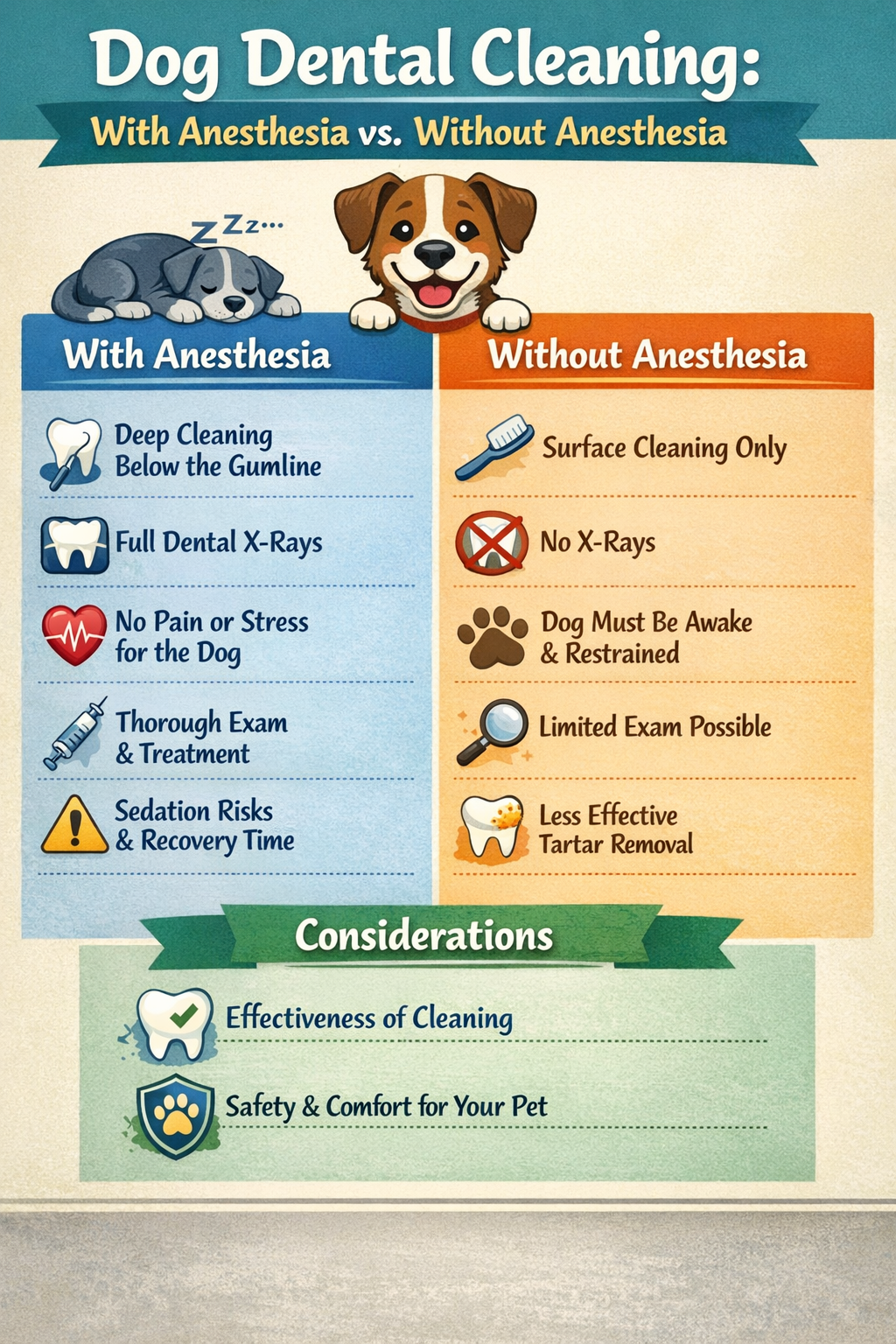
Anesthesia-free dental cleaning is a cosmetic procedure during which a provider (usually someone with experience in dog grooming but not a certified veterinary technician) performs superficial cleaning and polishing of your dog’s teeth. The procedure is done while your dog is fully awake. Most dogs require some level of restraint for the process, which is usually accomplished by wrapping or swaddling. A very calm, cooperative dog may need no restraint at all. But this circumstance is rare.
During anesthesia-free dental cleaning, the provider typically removes visible tartar on the dog’s teeth using a manual scaler and polishes and whitens the teeth. Although some providers market this procedure as a “deep cleaning,” this term is deceptive because it is virtually impossible to clean below the gum line while a dog is awake. The process also does not include x-rays or a detailed exam, so it cannot reveal invisible issues with the dog’s teeth and gums.
Many pet owners gravitate towards anesthesia-free cleaning because it offers a low-cost, sedation-free way to make their dog’s mouth look better and smell cleaner for some time. It is also considerably less expensive than a full dental exam and cleaning performed by a vet. For example, in Southwest Florida, the average cost of anesthesia-free dental cleaning in 2025 was about $150-$250, while a full cleaning in a veterinarian’s office, including preoperative blood work, anesthesia and X-rays, can be well over $1000
Dental cleaning under anesthesia
Considered by most veterinarians to be the “gold standard” of dental care, dental cleaning under anesthesia can only be performed by a licensed veterinarian or certified veterinary technician under the supervision of a licensed vet. During the cleaning process, the dog is fully anesthetized and unable to feel pain. This allows the vet staff to remove tartar under the gum line, probe any pockets found under or between the teeth, visualize all teeth surfaces, and perform extractions if necessary.
Before a dental cleaning under anesthesia, the vet will normally order blood tests to ensure that your dog has no underlying issues that could make anesthesia less safe, such as kidney or liver disease. These tests usually take a few days to come back, so the actual cleaning will generally be scheduled in a few days to a week. The vet will instruct you not to give your dog anything by mouth for about 12 hours before the appointment time to reduce the risk of vomiting while they are anesthetized.
On the day of your dog’s procedure, they will be given an injection to make them sleepy and relaxed. Vet staff will then place an intravenous catheter that will be used to give your dog fluids and provide IV access in case of emergency. The vet will then insert an endotracheal tube into the dog’s airway and begin administering inhaled anesthesia (a gas), which ensures that your dog stays unconscious during the entire cleaning. The endotracheal tube also ensures that your dog’s airways stays open and no fluid, tartar or debris from the oral cavity enters the lungs.
Once your dog is asleep, the vet or vet tech will usually take a set of full-mouth Xrays to look for any active dental disease. Next they will do a full dental exam, probing along the gum line for any pockets that might indicate advanced periodontal disease. If your dog has any loose or diseased teeth that need to be removed, the vet will proceed with extractions before cleaning the rest of the teeth. When any extractions are complete, they will use an ultrasonic scaler to clean all surfaces of the teeth. The final step in the process is polishing, and then your dog is ready to wake up. They will usually be sent home with pain medication and, possibly, antibiotics if any extractions were done.
Comparison Of Costs Of Dental Cleaning In Southwest Florida- 2025*
| Service Type | Estimated Cost Range | Notes/Source |
| Professional dental cleaning under anesthesia (vet) | $340 – $1,100+ | For routine cleaning including scaling, polishing, anesthesia, and often Xrays; prices vary widely between general vets and specialists. (Cape Coral Pet Vet) |
| Veterinary dental special-focused clinic cleaning (e.g., board-certified or dental-focused) | $600 – $1,500+ | Specialty or advanced care clinics like Pet Dental Center often charge higher for advanced imaging and comprehensive periodontal treatment. (Vety) |
| Anesthesia-free (no-sedation) dental cleaning | $179 – $300+ | Mobile or boutique services (not clinic-based)—local vendors in flex range. (Pawsome Smile) |
| Low-cost clinic or shelter dental specials | ~$199 – $300 | Some local aid clinics may offer reduced-rate anesthetized cleanings (if qualifying criteria met). (Florida Aid to Animals) |
*Prices may vary significantly. Always verify cost with your service provider before committing to a treatment plan.
What are the benefits of anesthesia-free dental cleaning?
The primary benefit of anesthesia-free dental cleaning is that it avoids the risks associated with sedation. Anesthesia techniques are generally safer today than they were in the past, but general anesthesia still carries risks. These range from mild nausea and vomiting in the post-anesthesia period to serious complications such as low blood pressure, aspiration pneumonia, or even cardiac arrest. Anesthesia risks are typically higher if a dog is:
- Very elderly or very young
- Acutely ill
- Suffering from heart, lung or liver disease
Brachycephalic dogs such as pugs, French bulldogs and Boston terriers are also at increased risk due to their short snouts and unique physiologic makeup, according to the American Animal Hospital Association.1
As mentioned previously, sedation-free dental cleaning is also considerably less costly than a full dental exam and cleaning. It also avoids the recovery period completely. Your dog will be awake and alert and able to eat and drink normally immediately after the procedure is complete.
What are the cons of anesthesia-free dental cleaning?
Unfortunately, despite its lower cost and cosmetic benefits, there are many drawbacks ro anesthesia-free dental cleanings, and it is not recommended by most professionals. According to guidelines from the American Animal Hospital Association “all pets, old or young, need to be anesthetized for their teeth to be cleaned, charted and X-rayed properly and safely.” Position statements from the American Veterinary Dental College and the World Small Animal Medical Community strongly agree. The reasons for their positions are many, including:
- Fear, pain and anxiety: Swaddling or immobilizing an animal is traumatizing and frightening, even without the added stress of holding the mouth open and using instruments to scrape and polish the teeth. Further, manual scaling around the gum line, even when done carefully, can cause significant pain. The dog may bite the provider or injure themselves trying to escape.
- No opportunity for treatment: Even if serious issues such as a fractured or loose tooth are detected during a no-sedation cleaning, the problem cannot be immediately addressed. Your dog will still need to visit a veterinarian and undergo general anesthesia to treat the problem appropriately.
- Risk of aspiration: Scaling and polishing a dog’s teeth release tartar, bacteria and other debris into the mouth, which can be inhaled and enter the bronchi or lungs. When your dog is under anesthesia, their airway is maintained by a cuffed breathing tube, which not only prevents any material from entering the lungs but also protects the airway and allows supplemental oxygen to be delivered if required.
- Unaddressed, chronic pain: Serious dental issues such as broken teeth, abscesses, or chronic periodontal disease that go undetected by anesthesia-free dental cleaning can cause severe, ongoing pain. Most dogs hide pain well, so they may suffer needlessly before you notice that something is wrong.
Is anesthesia-free dental cleaning ever appropriate?
While most professional veterinary organizations advice against anesthesia-free dental cleaning due to the reasons mentioned above, it may be reasonable to choose this option in certain limited circumstances. For example:
- A dog that has regular dental cleanings under anesthesia by a licensed veterinarian may benefit from anesthesia free-dental cleaning in between.
- A calm, cooperative dog that has very little dental tartar may be able to forgo a “full dental” for a year or more if they have anesthesia-free dental cleaning regularly
- A very elderly dog whose owner wants to avoid anesthesia but wishes to gain the cosmetic benefit of whiter teeth and a fresher-smelling mouth might choose anesthesia free cleaning to achieve that end.
Importantly, limited financial resources should not be a reason to opt for anesthesia-free dental cleaning for your dog. While it may appear on the surface that a superficial cleaning is “better than nothing,” research shows that it provides no medical benefit in the prevention or treatment of periodontal disease. If finances are an issue, it might be wiser to speak to your veterinarian about paying for the procedure over time (if you are an established patient, your vet may agree). Alternatively, you can schedule the procedure 3 to 6 months in advance and prepay over time. Options such as CareCredit or Scratch Pay are another possibility for individuals who qualify, offering low-interest or deferred-interest loans of varying amounts based on your location and credit score.
What questions should you discuss with your vet?
As with any decision about your dog’s health, you should discuss your concerns about dental cleaning, both with anesthesia and without, with your vet. Each dog is different, and while the consensus among veterinary professionals is clear, your vet may have different advice about your dog. To make the discussion easier, below is a brief synopsis of what you might wish to ask.
Your Dog’s Specific Risk
- Based on your preliminary exam, what level of dental disease do you see right now?
- Do you see signs of gingivitis, periodontal disease, loose teeth, or infection?
- Does my dog have any health conditions (heart, kidney, liver, airway issues, anxiety) that change the risk profile for anesthesia?
- If we do nothing for 6–12 months, what problems are most likely to develop?
Dental Cleaning Under Anesthesia
- What exactly is included in the procedure and cost. (Scaling above and below the gumline? Polishing? Dental X-rays? Extractions if needed?Dental sealant?)
- What pre-anesthetic testing do you recommend (bloodwork, chest X-ray, ECG)?
- How do you monitor my dog during anesthesia? (IV catheter, fluids, blood pressure, oxygen, temperature, ECG)?
- What are the main risks of anesthesia for my dog specifically?
- How often do anesthesia complications happen in your practice?
- How long is recovery, and what should I expect the first 24–48 hours?
- How often would you recommend repeat cleanings going forward?
Anesthesia-Free Dental Cleaning
- What exactly can and can’t be done without anesthesia?
- Can you clean below the gumline or only the visible surfaces?
- How do you handle a dog that is anxious or resists restraint?
- Is there a risk of missing painful disease under the gums or in tooth roots?
- Could this give a false sense of security if deeper disease is present?
- If we do this first, could it delay necessary treatment and make problems worse?
Outcomes & Value
- In your experience, which option actually improves oral health, not just appearance?
- How long will the benefits last with each option?
- (If cost is a concern)Is there a way to combine both methods to save money over the long term?
Key Takeaways
- Sedation-free dental cleaning is a cosmetic procedure. It provides no benefit in the treatment or prevention of peridontal disease in dogs.
- Anesthesia-free dental cleaning may miss significant dental issues such as fractured teeth, bone loss, and severe periodontal disease.
- Dental cleaning under anesthesia is considered the “Gold Standard” of dental care by most veterinary organizations
- General anesthesia for dogs is generall considered extremely safe. The risks of anesthesia are minimized by modern veterinary practices, including a physical exam and blood tests before the procedre, intubation to protect the dog’s airway, supplemental oxygen as needed and continuous monitoring while the dog is asleep.
References
Pet dental cleanings: what happens? (n.d.). http://www.campbellrivervet.com. https://www.campbellrivervet.com/resources/blog/may-2022/pet-dental-cleanings-what-happens
Anesthetic considerations for brachycephalic dog breeds – AAHA. (2025, February 13). AAHA. https://www.aaha.org/trends-magazine/publications/anesthetic-considerations-for-brachycephalic-dog-breeds/
Knutson, K., Dobbs, K., Krater, E., & Kadrlik, J. (n.d.). Client handout Pets need anesthesia for routine dental care. https://www.aaha.org/wp-content/uploads/globalassets/02-guidelines/dental/clienthandoutdentalcare.pdf?utm_source=chatgpt.com
American Veterinary Dental College. (2004). Companion animal dental scaling without anesthesia. https://avdc.org/PDF/Dental_Scaling_Without_Anesthesia.pdf
American Veterinary Dental College. (2004). Companion animal dental scaling without anesthesia. https://avdc.org/PDF/Dental_Scaling_Without_Anesthesia.pdf
Niemiec, B., Gawor, J., Nemec, A., Clarke, D., McLeod, K., Tutt, C., Gioso, M., Steagall, P.V., Chandler, M., Morgenegg, G. and Jouppi, R. (2020), World Small Animal Veterinary Association Global Dental Guidelines. J Small Anim Pract, 61: E36-E161. https://doi.org/10.1111/jsap.13132
 Verandah Pet Care